Sunday, 16 April 2023

Circular Sun Halo


"Many thanks to our sponsor Anita Roberts for taking this excellent photograph of a circular Sun Halo displaying sunlight being reflected and refracted by high altitude atmospheric ice crystals. Anita spotted this unusual occurrence and photographed it with her iPhone from the Jodrell Plank Visitor Centre.. The sun halo was easily detected with the naked eye but the colours due to refraction were better seen on the image. In all the halo lasted for over 20 minutes". Kurt Thrust current Director of the Jodrell Plank Observatory.

Venus, Mercury, the Hyades and the Pleiades over fields in Cambridgeshire


"Many thanks to, good friend of the Observatory,  Chrissy Roberts for sending us this image of the inferior planets Venus and Mercury seen shining brightly over Cambridgeshire. An excellent image taken with Chrissy's Smartphone and cropped and denoised by our own Pip Stakkert." Joel Cairo CEO of the Jodrell Plank Observatory.

Monday, 27 March 2023

The Moon up close.

Mare Nectaris  and surrounding geology. Enhanced colour shows differences in albedo which is related to surface mineralogy. Compilations of video clips taken with the Jodrell Plank 127mm Apo Refractor and a colour planetary video camera. Credit: Pip Stakkert.


" Jim Lovell was 95 years old this week. For the team here at the Jodrell Plank Observatory, he represents all that is admirable in human beings.  He is a modest and courageous man, who has in his public life and achievements demonstrated best practice in leadership and team management under the most difficult of circumstances. Happy Birthday Mr Lovell you are a true inspiration for us all." - Joel Cairo CEO of the Jodrell Plank Observatory.

Tuesday, 21 March 2023

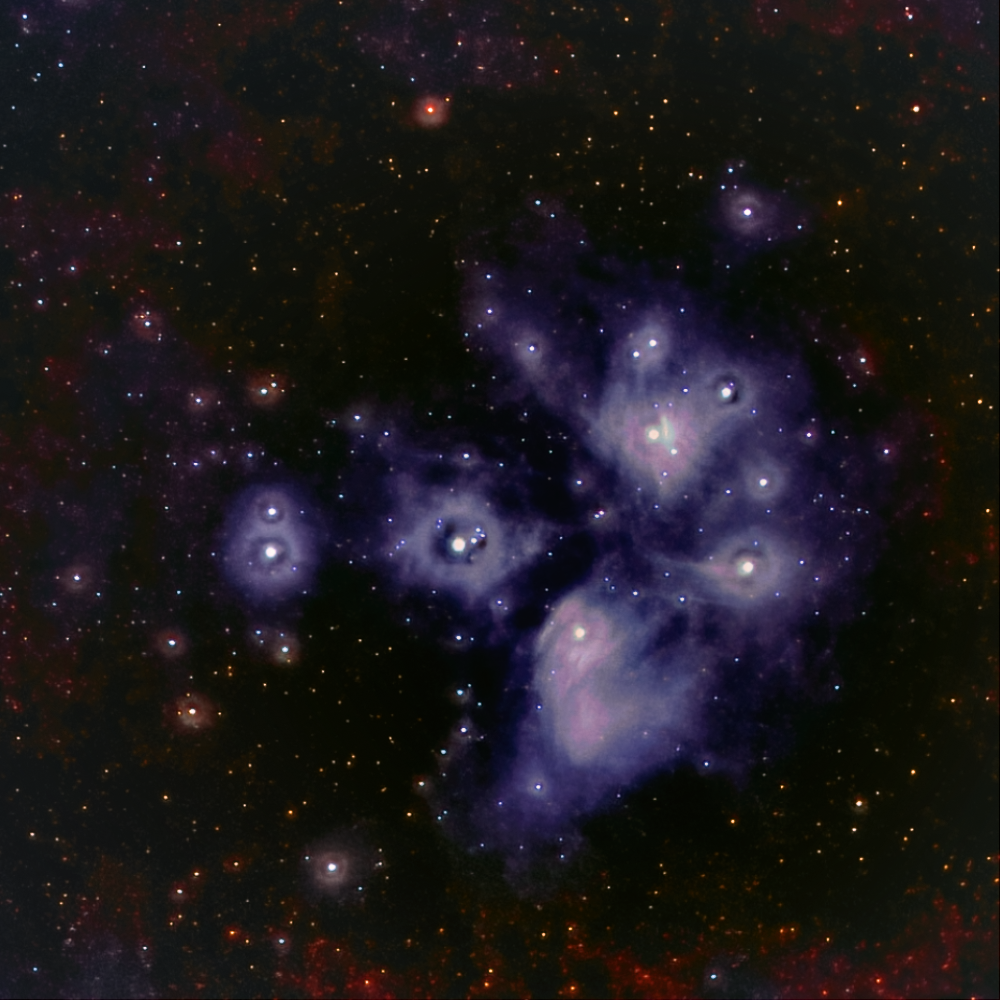
The Seven Sisters


The Pleiades  asterism in the Constellation Taurus; Jodrell Plank Observatory mini rig. Altair Lightwave 66mm doublet refractor, Canon 600d DSLR on Star Adventurer EQ mount. Credit: Kurt Thrust.


Pleiades map credit: By NASA, ESA and AURA/Caltech - Hubble Refines Distance to Pleiades Star Cluster (STScI-2004-20), Public Domain, https://commons.wikimedia.org/w/index.php?curid=17899258

"The freeware Starnet GUI works its magic on the Pleiades asterism bringing out detail in the the reflection nebulae. This group of young hot blue stars is currently passing through a cloud of interstellar dust which reflects the starlight. The Pleiades or the Seven Sisters is a relatively close open cluster of stars and is estimated to be some 444 light years distant from the Earth. The data for the image was captured at the Jodrell Plank Observatory in 2018"-. George Hammer resident geologist at he Jodrell Plank Observatory. 

Cropped image with colour of excited hydrogen gas enhanced. Credit: Pip Stakkert


Cropped version with reflection nebulosity enhanced (Kurt's favourite)


Wednesday, 15 March 2023

The Andromeda Group of Galaxies


The Andromeda Group of Galaxies Messier 31, Messier 32 and M110. Composite of two stacks of data to accommodate the the wide dynamic range. The data was re-processed by Kurt Thrust using Starnet GUI and Affinity Photo2. The original data was captured by the Jodrell Plank Observatory's mini rig.

Slightly different colour rendering

" The original data for this was captured in autumn 2016 using a Altair 66mm doublet refractor mounted on a Star  Adventurer EQ mount. When Pip Stakkert processed this data back in 2016, the outer spiral ring was not visible. The new freeware Starnet GUI in combination with Affinity Photo 2 has enabled fainter details to be displayed. We were astonished to see how well this little telescope performed capturing the outer spiral ring wrapping around M31 anticlockwise from right to left.  A plume of stars and gas can also be seen spiralling away from the smaller elliptical galaxy M110  bottom right. There is plenty of drama in this image as the galaxies gravitationally interact. 

To give some idea of scale; Messier 31- the large spiral Andromeda Galaxy is  approximately 150,000 light years (1.35 million trillion kilometres) across and contains stars with a mass equivalent of 1 trillion Suns. At the centre, somewhere in the bright core is an intermediate mass black hole with a mass equal to 100,000 Suns. Messier 32 can be seen in the image as a small blurry disc just above and to the left of the bright Andromeda core. It is an early type dwarf elliptical galaxy comprised of mainly old yellow and red stars. Messier 110 is also a dwarf elliptical galaxy and both M32 and M110 are gravitationally bound to Messier 31 as satellite galaxies. The trio of galaxies is located some 2.5 million light years away. M31 can be seen with the naked eye from a dark site and all three can be viewed with a good pair of binoculars" - Kurt Thrust current Director of the Jodrell Plank Observatory.

Finder chart for M31 Credit Stellarium and NASA


Monday, 13 March 2023

Messier 71 in the constellation Sagitta


Messier 71 reworked data 127mm Meade Apo Refractor Canon 400d DSLR. Credit : Pip Stakkert

"Weather in Lowestoft remains poor so Pip decided to use the new Starnet GUI software to rework data from Messier 71 in the constellation Sagitta. Sagitta is a very small and dim constellation that sits within the band of the Milky Way. Little knots of excited molecular gas can be seen in and around M71 in the above image.  Messier 71 is a loose globular star cluster with a diameter of 26 light years. It is 13,000 light years distant and has a mass equivalent 17,000 suns". Kurt Thrust current Director of the Jodrell Plank Observatory.

Sunday, 12 March 2023

The Practical Astronomy Show Kettering 2023


Anita and George Roberts co-sponsors of the Jodrell Plank Observatory

"Our sponsors Anita and George enjoying a day at the Practical Astronomy Show at the Kettering Conference Centre on the 11th March 2023. Many thanks to the nice guy on the TUFFTRUK stand who kindly offered to take the photograph. Very nice sturdy engineering for astronomers on the move on show from TUFFTRUK. ". - Joel Cairo CEO of the Jodrell Plank Observatory