|
| The Pleiades open star cluster visible within the stars of Taurus. Image Credit: Pip Stakkert |
"Last night there was a three hour break in the clouds over Oulton Broad and Messier45, or the Pleiades open star cluster, was visible above the Observatory. As we have never imaged this target at a low to intermediate focal length, we decided to give it a go. The image is from a stack of 1 minute and 2 minute exposures at ISO1600. Just over 2 hours of data in total was used to create the image. The equipment employed was: a modded Canon 200d DSLR, a triband filter and a Samyang 135mm F2 lens, (the F ratio was increased by using filter rings). The cluster is quite close to us at 444 light years and is clearly visible to the naked eye on a dark and clear winter's night. The 'reflection nebulosity' is being created by starlight reflected from a cloud of gas, which the hot blue cluster stars are currently moving through. The reflection nebula cannot be seen with the naked eye but if you can see and count seven stars you have excellent eyesight". - Joel Cairo CEO of the Jodrell Plank Observatory.
 |
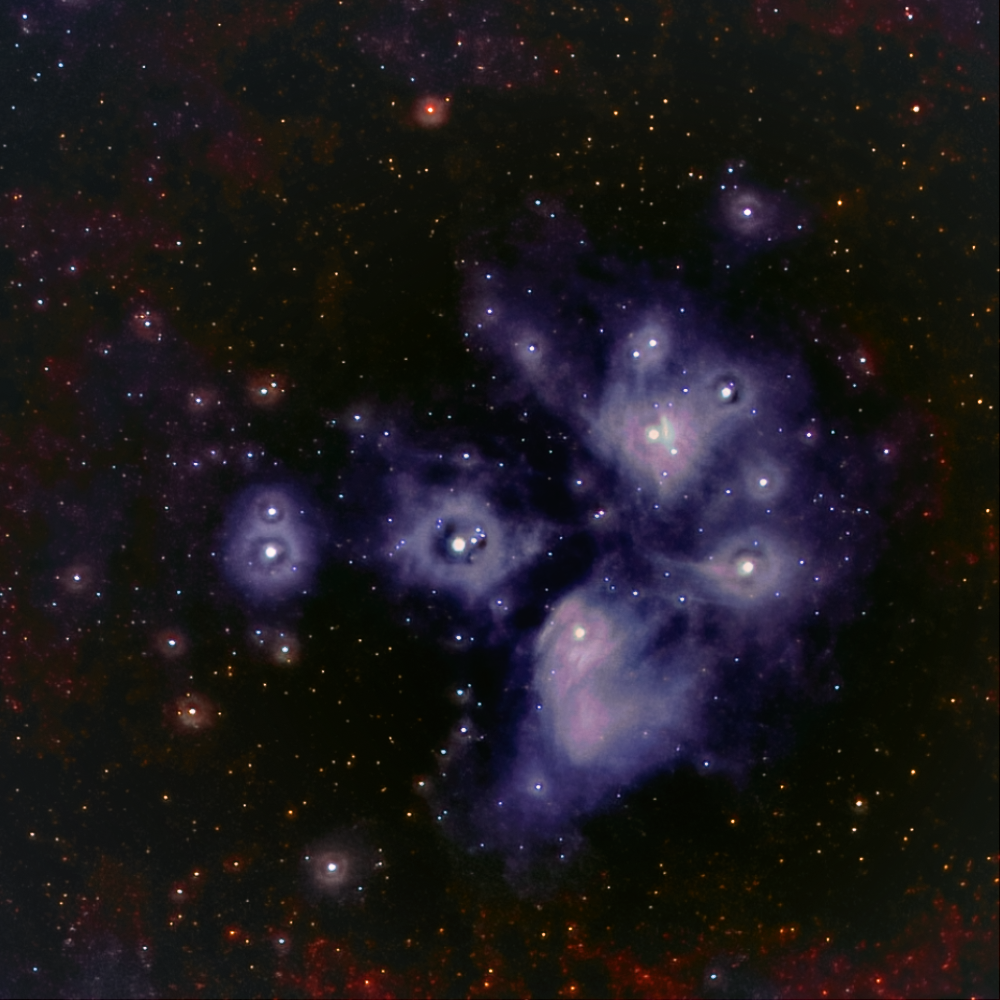
| 'The Seven Sisters' reprocess, rotate and crop. Image Credit: Kurt Thrust |
" In the end, Messier45 is all about the nebulous gas cloud the cluster is currently moving through. I therefore asked Kurt Thrust to reprocess the data and emphasise the 'wispy nebulosity' which surrounds the brighter elements" - Carl Segine Outreach Officer at the Jodrell Plank Observatory.
 |
| 'It's all about the gas' Image Credit: Kurt Thrust. |