Friday, 3 March 2023

Messier 85 in Coma Berenice


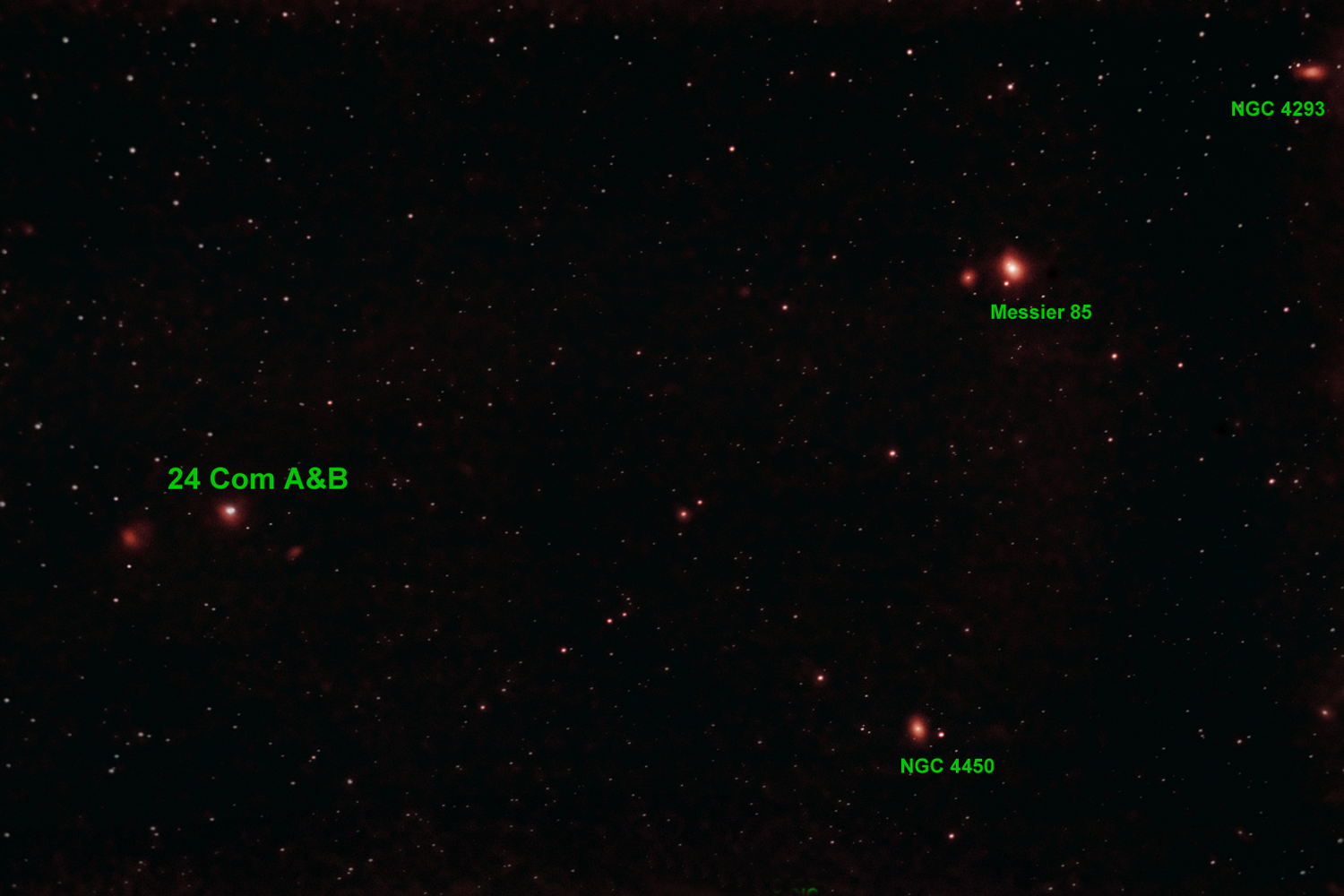
Messier 85, the star 24 Come Berenice and numerous other galaxies adjoining the constellation Virgo Credit: Pip Stakkert Re-work of data captured in March 2022

Annotated version of the above image. Details credit Astrometry.net

"Whilst we were out imaging the aurora over Lowestoft we noticed that the constellations Leo Major, Virgo and Coma Berenice were getting higher in the south eastern sky. Many galaxies are located in and amongst these constellations, which is collectively known as the 'Realm of Galaxies'.
Messier 85 is a lenticular galaxy some 125000 light years across and approximately 60 million light years distant. It is just a tiny smudge of light in this image but in reality it is enormous. The universe is vast and awash with interstellar gas and dust!" - Joel Cairo CEO of the Jodrell Plank Observatory.

Wednesday, 1 March 2023

Messier 37 revisited


Open Star Cluster Messier 37. 127mm Meade Apo Refracting telescope and Canon 600d DSLR. Stacked image. Credit; Pip Stakkert

" It turns out that taking good photographs of stars with a DSLR is quite difficult. The constellation Auriga is a favourite target at the Jodrell Plank Observatory. It holds a quite a few interesting objects, one of which is the wonderful open star cluster Messier 37 also known as NGC 2099. The cluster is on the edge of our galaxy, the Milky Way. When viewed from Earth, we observe M37  looking in the opposite direction from our galactic centre. The stars are approximately 500 million years old and have a combined mass of 1500 times that of the Sun. Amongst the cluster stars are at least a dozen red giant stars and one planetary nebula (toward the end stage for stars roughly the mass of our Sun). The cluster is approximately 4500 million light years away and covers an area of sky equivalent to about 25 light years. The cluster has over 500 identified stars gravitationally held together. The cluster can just be seen through binoculars from a dark location as a small hazy cloud. There are two other Messier open star clusters in Auriga. The red glowing clouds visible in other parts of our image are created by ionised atoms of hydrogen gas and cold dark dust in the interstellar medium" - Kurt Thrust current Director of the Jodrell Plank Observatory.

Tuesday, 28 February 2023

The Aurora over the Jodrell Plank Observatory 27th February 2023


The Auroral glow of pink and green looking north from Wood Lane Oulton. Fixed tripod mounted Canon 600d DSLR and EOS lens at f=18mm. A single 15 second RAW image at ISO6400. Credit: Kurt Thrust

" Our sponsor Anita Roberts alerted the Observatory Team to the possible visibility of the Aurora over Lowestoft. Kurt packed a camera and tripod and jumped with Anita into the car. The closest location offering an unobstructed view to the north is only half a mile from the Observatory . The aurora was just visible to the naked eye and was changing and moving quite rapidly.  The red glow created by excited nitrogen atoms was much easier to see than the green glow created by ionised oxygen which hugged the horizon.  Trial images showed that the aurora was visible from Lowestoft!
The above image is the best of ten images that showed auroral activity and some structure in the ionised oxygen". Joel Cairo CEO of the Jodrell Plank Observatory. 

Tuesday, 7 February 2023

Don't tell the kids


The Comet C/2022 E3 ZTF passing through the 'Kids' triangular asterism in the constellation Auriga the Charioteer.  A cropped stack of 35x1 minute light frames taken at f=18mm and ISO 1600 taken with a Star Adventurer EQ mounted un-modded Canon 600d DSLR. Credit: Kurt Thrust.

" In between the clouds and the full Moon rising above the rooves to our east,

Thursday, 2 February 2023

Long Period Comet C/2022 E3 ZTF in the constellation Ursa Minor


Comet C/2022 E3 ZTF. Image acquired on 29- Jan 2023. Captured with the Observatory Canon 600d DSLR and 135mm F2 Samyang lens all mounted  on the Star Adventurer EQ mount. A crop of a stack of 40x 60sec light frames at ISO400. Processed using DSS, APS, Affinity Photo2, StarnetGUI, GraXpert, Topaz DenoiseAI and Fitswork4.
Credit: Kurt Thrust

"The Jodrell Plank team were all out to view the comet through binoculars on the one clear night we have had for some time. Unfortunately, imaging the comet was complicated by the strong moonlight, the local light pollution and the intermittent cloud. The comet should be visible all month and by the 5th of February will be close to the very bright star Capella , the alpha star in the constellation Auriga the charioteer. The comet is a visitor from the Oort cloud and last came this close to the Earth some 50,000 years ago when Neanderthals roamed over northern Europe. God knows what will have become of humanity by it's next return. 

Approximate location of the comet on the night of 29- Jan 2023 Credit :Astrometry Net


The uncropped version of the stack showing the comet against the background star field. Credit: Pip Stakkert.

A re-work of the data using some images of the overcast sky, which followed on the light frames in the imaging run, and was used as flat frames divided mathematically into the stack of light frames. This method removed much of the moonlight and light pollution without adding processing artefacts. The Comet's ion tail is well brought out by this processing method. Credit: Pip Stakkert


Annotated version . Credit: Astrometry net.

When imaged, the comet was tracking through an area of sky with few bright objects. An object of interest captured in the wide field view is the star Tonatiuh.  This star is thought to have an exo-planet. 

In 2003, radial velocity measurements made by the Okayama Planet Search Program led to the announcement of an exoplanetary companion. It is orbiting at a distance of 0.95 AU,  with a period of 199.5 days and with an eccentricity of 0.09. Since the inclination of the exoplanet's orbital plane is unknown, only a lower limit on its mass can be determined. It has at least 8.3 times the mass of Jupiter." - Kurt Thrust current Director of the Jodrell Plank Observatory.

Sunday, 29 January 2023

First Lights at the Jodrell Plank Observatory 2023


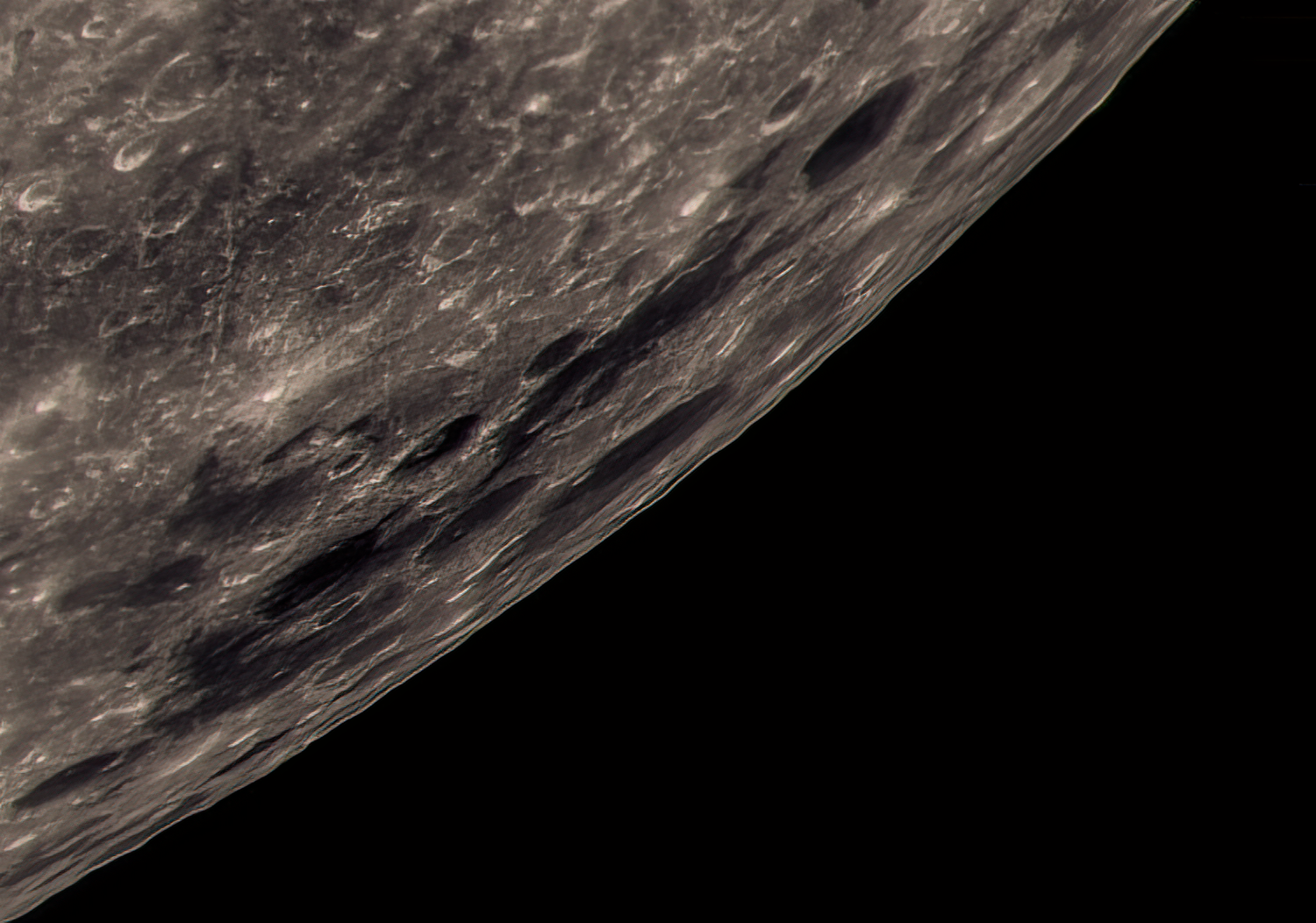
02 January 2023. The Moon was waxing gibbous and libration favoured imaging the southern limb. Mare Australe area.
127mm Meade Apo Refractor, x3 Televue Barlow and the QHY5-llc planetary video camera. A stack of 3000 avi frames.

Pipp Stakkert has identified the craters/walled plains  Oken and Lyot in order that 
they can be more easily located on the lunar globe.


The only reason we captured this image was to achieve an accurate focus on a bright object before we attempted to capture a video clip of the much dimmer and distant planet Mars. So on the night we did not take much interest in what bit of the Moon we were capturing. 

Since then all members of the Jodrell Plank Observatory staff have succumbed to post Christmas viruses and consequently little imaging work has been accomplished. Bad weather has also played its part in keeping the team indoors.

When we finally got around to processing the lunar clip we weren't sure which bit we had captured. This may seem silly but the Moon's phase (how obliquely it's illuminated by the sun) and it's libration (the Moon appears to wobble and from time to time presents a bit more of its surface at the limb) makes quite a difference to how lunar features appear. We thank PeterW and Mr Spock from SGL for their advice and Nasa for their imagery.

The Moon is tidally locked to the Earth and so presents more or less the same face towards us. As a consequence roughly circular craters and lava flooded plains located close to the lunar limb appear elliptical. If we viewed Mare Australe from directly above it would look quite different. We can of course do this as NASA generously shares its imagery from countless automated space probes and the Apollo programme.

Mare Australe from above. Credit: Nasa Gov

 I particularly like the following image taken by the crew of Apollo 15 looking towards the South Pole as the craft orbited above the lunar surface.


It is quite interesting to view the whole Lunar surface from a different perspective. The following NASA image is the Moon as seen from approximately above the South Pole.
Pipp Stakkert has coloured and identified the locations of Oken and Lyot.


And finally what all the focussing on the Moon was for our best image of Mars this season with the surface albedo feature 'Syrtis Major' just coming into view. Mars disc is now smaller and just beginning to show some phase. There is also quite a bit of carbon dioxide haze and cloud about.


Sunday, 22 January 2023

Comet ZTF (C/2020 V2)


Widefield image taken with the Canon 600d Camera and an EOS telescopic lens at approx f=200mm. all mounted on a Star Adventurer Equatorial mount. The image is a stack of 10 x 2 minute exposures at ISO1600. Credit: KurtThrust 

The comet is travelling through a star, gas and dust rich region in the constellation Cassiopeia. The star Segin is also known as Epsilon Cassiopeia.

Star Map credit Wikipedia

A cropped enlargement of the widefield image that shows the comet nucleus and smudge of a tail more clearly. Credit: Pip Stakkert.

Re-work of data using a combination of techniques and software but mainly reducing stars and hydrogen alpha background

"The comet is very faint and at approximate magnitude +10, well below naked eye visibility. It is currently 320 million km distant from the Earth and will be at its closest in September this year. The comet is on a hyperbolic orbit and has travelled from the Oort Cloud". - Kurt Thrust current Director of the Jodrell Plank Observatory.

For more information on the Oort Cloud