![]() |
| The Auroral glow of pink and green looking north from Wood Lane Oulton. Fixed tripod mounted Canon 600d DSLR and EOS lens at f=18mm. A single 15 second RAW image at ISO6400. Credit: Kurt Thrust |
![]() |
| The Auroral glow of pink and green looking north from Wood Lane Oulton. Fixed tripod mounted Canon 600d DSLR and EOS lens at f=18mm. A single 15 second RAW image at ISO6400. Credit: Kurt Thrust |
![]() |
| Approximate location of the comet on the night of 29- Jan 2023 Credit :Astrometry Net |
| The uncropped version of the stack showing the comet against the background star field. Credit: Pip Stakkert. |
![]() |
| Annotated version . Credit: Astrometry net. |
Since then all members of the Jodrell Plank Observatory staff have succumbed to post Christmas viruses and consequently little imaging work has been accomplished. Bad weather has also played its part in keeping the team indoors.
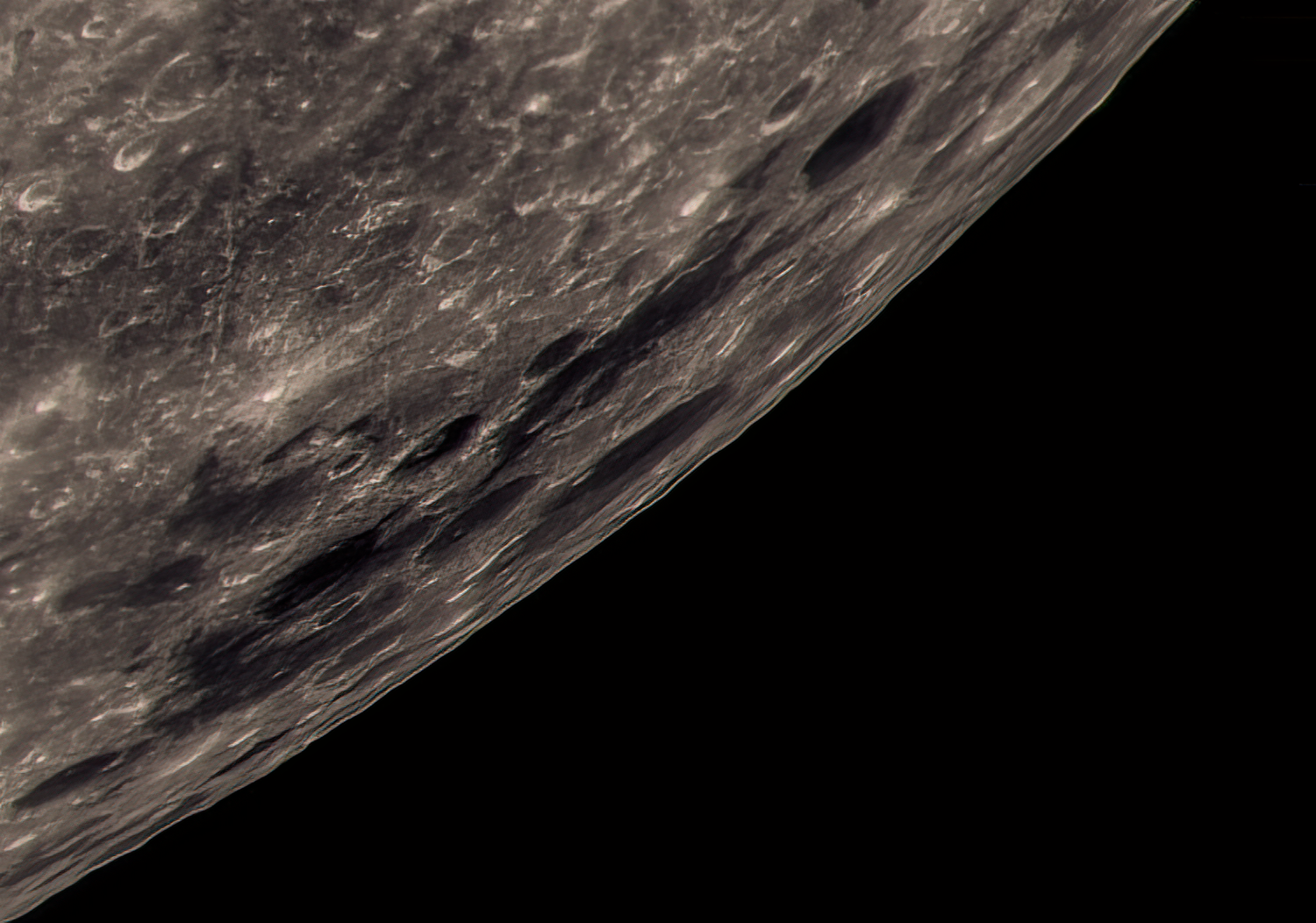
When we finally got around to processing the lunar clip we weren't sure which bit we had captured. This may seem silly but the Moon's phase (how obliquely it's illuminated by the sun) and it's libration (the Moon appears to wobble and from time to time presents a bit more of its surface at the limb) makes quite a difference to how lunar features appear. We thank PeterW and Mr Spock from SGL for their advice and Nasa for their imagery.
The Moon is tidally locked to the Earth and so presents more or less the same face towards us. As a consequence roughly circular craters and lava flooded plains located close to the lunar limb appear elliptical. If we viewed Mare Australe from directly above it would look quite different. We can of course do this as NASA generously shares its imagery from countless automated space probes and the Apollo programme.
![]() |
| Mare Australe from above. Credit: Nasa Gov |
![]() |
| The comet is travelling through a star, gas and dust rich region in the constellation Cassiopeia. The star Segin is also known as Epsilon Cassiopeia. |
![]() |
| Star Map credit Wikipedia |
![]() |
| A cropped enlargement of the widefield image that shows the comet nucleus and smudge of a tail more clearly. Credit: Pip Stakkert. |
![]() |
| Re-work of data using a combination of techniques and software but mainly reducing stars and hydrogen alpha background |
"The comet is very faint and at approximate magnitude +10, well below naked eye visibility. It is currently 320 million km distant from the Earth and will be at its closest in September this year. The comet is on a hyperbolic orbit and has travelled from the Oort Cloud". - Kurt Thrust current Director of the Jodrell Plank Observatory.
For more information on the Oort Cloud
" Mars has been shining red and bright in the night sky and has been moving steadily west until it came to opposition in early December 2022. Mars having been overtaken by Earth on its inner orbit, has now an apparent retrograde motion and is moving east amongst the stars of Taurus. The weather over Lowestoft has been mixed and unfortunately we have only managed two nights, one in November and one in December when we could image Mars using our large refracting telescope. Both polar icecaps are visible on the image captured in November but by December the southern ice cap has been diminished in the relative heat of the southern hemisphere summer. The enormous shield volcano, Olympus Mons is clearly visible in the image captured in December. The later image also shows increased carbon dioxide clouds in the Northern hemisphere" - Joel Cairo CEO of the Jodrell Plank Observatory