Showing posts with label Comet C/2020 F3 NEOWISE. Show all posts

Tuesday, 28 July 2020

Through the Window


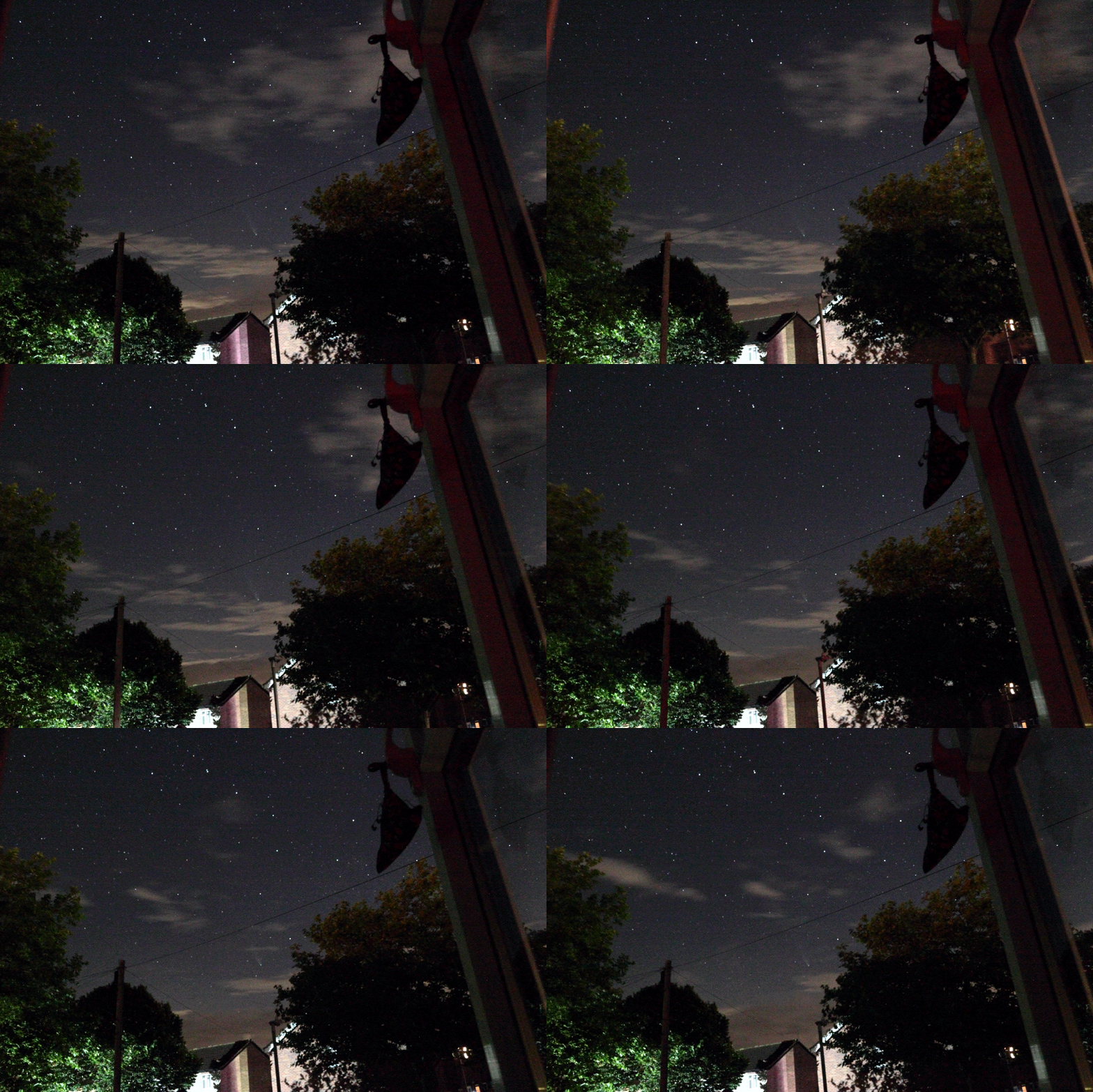
Comet C/2020 F3 NEOWISE at nearest point to Earth. Taken with a tripod mounted Canon 600d DSLR at  f=18mm and ISO3200 a stack of 6 x 10 second frames using the freeware Sequator. Credit: Joel Cairo and Pip Stakkert.

Comet C/2020 F3 NEOWISE animated GIF from 20x10 sec frames. No shortage of clouds or wind here on the UK East Coast. Credit Pip Stakkert
" The above images were taken looking north from an upper floor window of the Jodrell Plank Observatory Visitor Centre. The comet was approximately 64 million miles away, moving quickly across the northern sky under the Great Bear constellation and the Plough asterism. The comet is now heading back out to the icy extremities of the Solar System.  Farewell until your return in AD9020.

Pip Stakkert used the freeware astro-stacking programme Sequator for the first time. This is a very useful program for stacking images where static foreground landscape elements are to be integrated with the more dynamic objects in the sky. Thanks go to the Sky at Night magazine for bringing this software to our attention" - Kurt Thrust current Director of the Jodrell Plank Observatory.

Monday, 20 July 2020

Comet nearing closest Approach

Comet C/2020 F3 NEOWISE - the Comet is almost at its closest to the Earth and looking very beautiful low on the Northern Horizon as viewed from the Jodrell Plank observatory Visitor Centre. The image is a stack of 9 x 30 sec RAW lights at ISO 1600 taken with the 66mm Altair Lightwave Doublet and Canon 600d DSLR with 0.8x focal reducer and field flattener - mounted on a Star Adventurer equatorial mount. Credit: Joel Cairo - CEO at the Jodrell Plank Observatory.
"The comet will be at its nearest to the Earth this week and consequently moving very quickly across the sky. It's developing tails now stretch over six degrees across the telescopic view. The comet has both a very obvious yellow dust tail and a much fainter and separate bluish ion tail. The fainter tail is an ion tail, formed as ions from the cometary coma are dragged outward by magnetic fields in the solar wind and fluoresce in the sunlight. The tails of comet NEOWISE are reminiscent of the even brighter tails of Hale Bopp, the Great Comet of 1997.
The Jodrell Plank Observatory has gained a new CEO and astrophysicist from Valletta University - Joel Cairo. Everyone here at 'Jodrell Plank' wishes him a happy stay and look forward to his contributions to the astronomical work carried out here on the East Coast. Joel has a considerable reputation in the practice of astro-science and falconry". - Kurt Thrust current Director of the Jodrell Plank Observatory.

Monday, 13 July 2020

A Great Comet - Comet C/2020 F3 NEOWISE 2:00am BST 13 July 2020


Comet C/2020 F3 NEOWISE was visible of the Jodrell Plank Observatory in the early hours of the morning - Images taken with a Canon 600d DSLR tripod mounted.Capella is the bright star above and to the right of the comet. Credit: Kurt Thrust and Pip Stakkert.
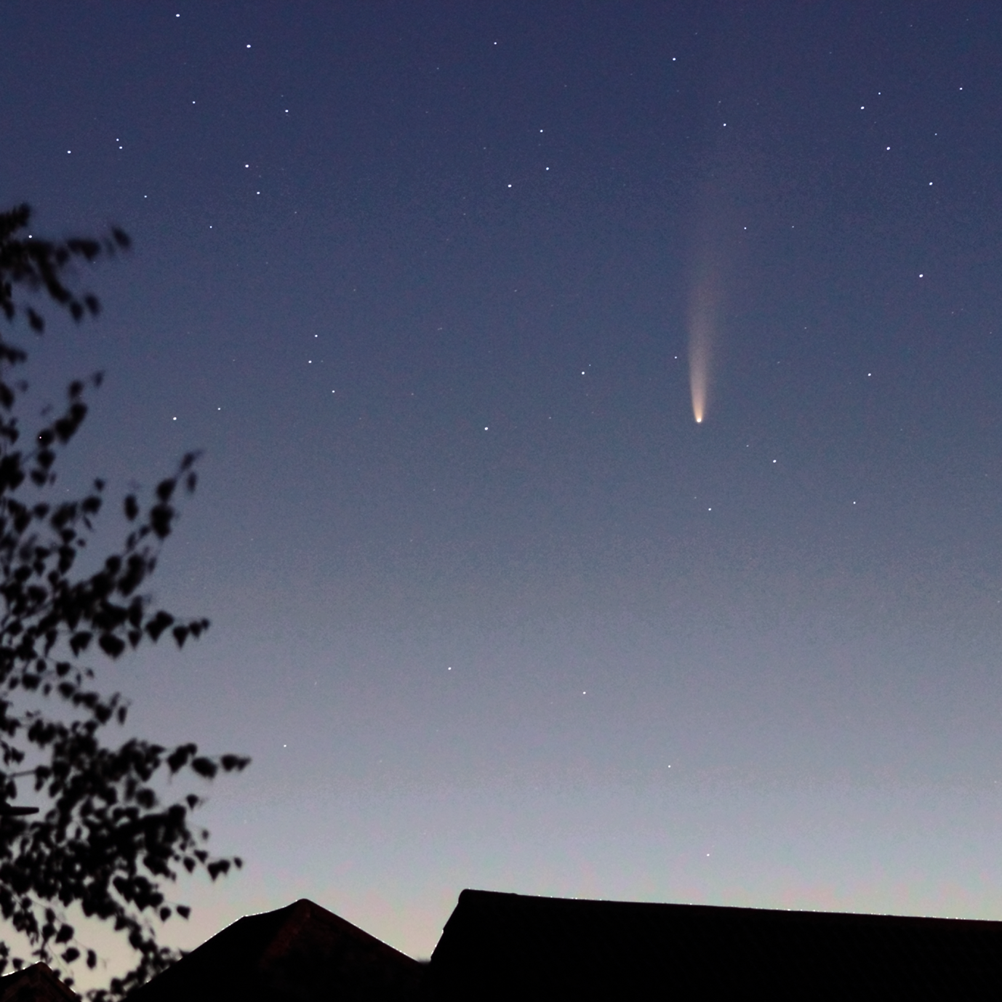
 Bright comets, visible to the naked eye are seldom visitors to the night sky. Comet 2020 F3  NEOWISE became visible in the Northern Hemisphere quite recently. It is the brightest Comet since Hale Bopp graced our skies in the 1980s. It is a very beautiful object and displays a visible tail at least as long as two Moon diameters. The Jodrell Plank team had been out imaging the planets Saturn and Jupiter with the Observatory 'mini-scope-rig'. When they completed their imaging session, they decided to check  the sky to the North of the Visitor Centre and were surprised to see the bright comet low under Capella the alpha star in the constellation Auriga.  The comet may be seen without any visual aids but looks particularly beautiful through the observatory wide-field binoculars. If you are a night owl and the weather is kind why not take a look low in the north. Night by night it will move further west and by the end of the month it will sit in the constellation Ursa Major (The Great Bear) and under the 'Plough' asterism. Towards the end of July, it will be visible in the evening as well as in the early morning  and will be closest to the Earth at a distance of 64 million miles. The comet's nucleus made up of dust, ice and organics is estimated to have a diameter of 5 kilometres and the dust tail covers some six degrees in the sky. The comet is now on its way out of the Solar System and will not return for 7000 years. Catch-it while you can this is an exceptional event" - Kurt Thrust acting CEO and current Director of the Jodrell Plank Observatory